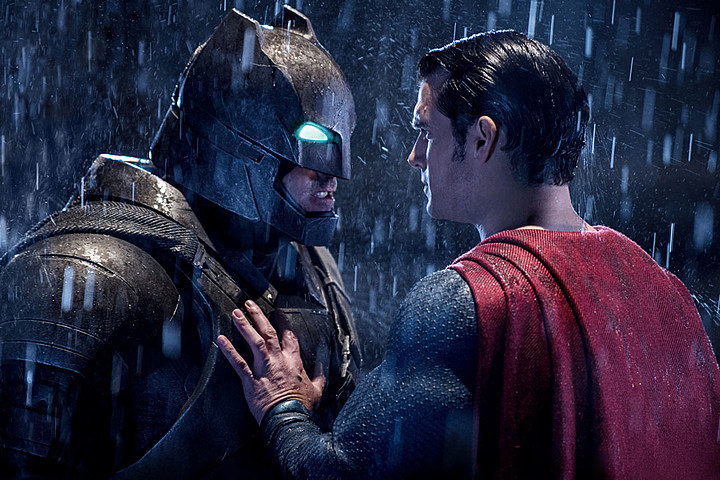
Zack Snyder makes superhero motion pictures, however his characters don't act extremely chivalrous. Batman v Superman: Dawn of Justice elements the various trappings of the superhero type: Capes, contraptions, abnormal muscles, punching stuff. Be that as it may, the two stars aren't honorable, sacrificial, or gallant; they're rough, forceful, and furious — for the most part at each other rather than the terrible folks. In Snyder's detailing, shielding the world from wickedness isn't a blessing or a calling; it's a weight. Furthermore, that inclination is reflected in the film itself, a troublesome 150-minute trudge around two men battling about who is in the right when both are plainly in the off-base.
Day break of Justice is a spin-off of Snyder's past superhero motion picture, the Superman reboot Man of Steel, furthermore an adjustment of the response to it. In spite of the fact that Man of Steel was an overall film industry hit, a few groups of onlookers (counting this commentator) responded contrarily to the end of the film, where Superman (Henry Cavill) battled General Zod (Michael Shannon) through the roads and skies of Metropolis with minimal clear respect for the hundreds or even a huge number of individuals biting the dust surrounding him. Was this behavior unbecoming of a Superman? Did he act neglectfully? Is it accurate to say that he was in a roundabout way in charge of the passings of the honest individuals? Fans have contended those focuses throughout the previous three years.
Batman v Superman starts by transforming that civil argument into content, with Bruce Wayne (Ben Affleck) touching base in Metropolis (which in this film is to Gotham as Minneapolis is to St. Paul) amid the climactic fight in the middle of Superman and Zod. He witnesses the decimation firsthand, observing powerlessly as Wayne Enterprises' Metropolis workplaces breakdown after a volley of warmth vision. year and a half later, even as he proceeds with his undeniably vicious one-man war on wrongdoing in Gotham City as Batman, Wayne fixates on Superman and his unchecked forces.
He's not the only one. After Superman's activities amid a salvage of Lois Lane (Amy Adams) result in more passings, a Congressional hearing is called to examine his place on the planet, headed by Senator June Finch (Holly Hunter). What's more, back in Metropolis, virtuoso industrialist Lex Luthor (Jesse Eisenberg) plans to get his hands on Kryptonite, the one substance that could hurt Superman and possibly reestablish harmony to a world where mankind all of a sudden appears to be more undermined than any time in recent memory.
There are enormous profound subjects at work here, and much more than in Man of Steel, Snyder ponders the mental scars of 9/11 and our general public's all-expending want for security in an indeterminate world. However, the world's relationship to Superman in Dawn of Justice is perplexing; in one scene, he's respected as a divine being, in the following, he's pulled before the Senate as a hazard. He's attacked for this thing including Lois that happens ahead of schedule in the motion picture, yet he's evidently seen as a legend for the Zod stuff — there's even a statue in his honor! — when obviously thousands more died in that occurrence.
Congressperson Finch says at one point that "majority rules system is a discussion," and maybe demonstrating these clashing perspectives of Superman is Snyder's method for belligerence the same. Yet, this sort of examination concerning the way of gallantry requires shades of dark, while Snyder just traffics in absolutes, with characters making ham-fisted discourses about lack of awareness and guiltlessness and after that showcasing their supreme marvelousness in enormous, flashy, and at times shockingly merciless activity arrangements. (Despite the fact that this film most likely falls inside of the course reading meaning of a PG-13, it's dim and aggravating in ways that ought to make folks with little children reconsider before purchasing tickets.) And regardless of the possibility that Snyder trusts Superman's activities were legitimized in Man of Steel, when Batman v Superman slopes up to scenes of citywide decimation, he embeds lines of dialog about how this island is "uninhabited" and how that a portion of Metropolis is "practically unfilled" on the grounds that it's after work. Following two hours raising issues about obligation and open security, he finds an advantageous reason for simple smashy.
Ben Affleck makes a competent Batman, regardless of the possibility that his character is rendered a reckless dope by David S. Goyer and Chris Terrio's screenplay. (For the "World's Greatest Detective," Affleck's Dark Knight is effortlessly controlled.) And Henry Cavill remains a strong Superman. Humorously, however, the best character is the person who got left off the marquee: Gal Gadot's Wonder Woman. It's never clarified why she's meandering through Metropolis and Gotham, and she doesn't have a great deal to say, yet in a motion picture where nobody else ever quieted down, that is an invigorating change of pace. All the more critically, she radiates a charming atmosphere of puzzle and power whether she's playing with Bruce Wayne or giving a good old fashioned thumping to Doomsday. In the case of nothing else, Batman v Superman makes you eager to see Gadot become the overwhelming focus in her performance Wonder Woman film, due out in theaters next summer. (It certainly doesn't make you trust Lex Luthor gets his own particular spinoff; Eisenberg's wide, Schumacheresque execution has a place with a prior, goofier period of superhero motion pictures.)
The issue with Wonder Woman — and the issue with a great deal of Batman v Superman — is that she for the most part exists to keep the title characters separated while the plot wastes its time for very nearly two hours of dreary dialog, dream arrangements, bad dreams, and teases of future DC Comics films (Gadot's Wonder Woman is only one of a whole slate of motion pictures anticipated that would take after Batman v Superman.) Snyder is by all accounts shooting for The Empire Strikes Back; the enormous, serious center section of an epic adventure. Be that as it may, he's injury up at something closer to Iron Man 2; a bloated, disappointing superhero serial including a hero swarmed out of his own film by a second star, a cluster of scoundrels, and the commitment to lay huge amounts of realistic universe preparation.
There's presumably a truly fascinating film about the ideological partition in the middle of Batman and Superman, however on the premise of Dawn of Justice, I'm not certain Zack Snyder was the man to make it. The inquiries he asks are excessively direct and the determination he touches base at after all that discussion and excessively few setpieces is much excessively straightforward. Rather than playing up the contrasts between the Man of Steel and the Dark Knight, Batman v Superman smoothes them. For all his high-horsing about Superman's transgressions, Batman cuts down heaps of individuals in his Batmobile and Batwing (both furnished with huge assault rifles) and he pummels awful folks with disturbing savagery (he incapacitates no less than one person forever, if the poor man gets by any stretch of the imagination). On occasion, Affleck's Bruce Wayne appears to be less agonized over Clark Kent's forces than envious of them. This Batman might be right about this Superman, but on the other hand he's a wolf in sheep's clothing. In the event that he'd quit attempting to kill him for two minutes, he'd understand the amount they have in like manner. Batman and Superman have no motivation to battle. These two "legends" merit each other.
Day break of Justice is a spin-off of Snyder's past superhero motion picture, the Superman reboot Man of Steel, furthermore an adjustment of the response to it. In spite of the fact that Man of Steel was an overall film industry hit, a few groups of onlookers (counting this commentator) responded contrarily to the end of the film, where Superman (Henry Cavill) battled General Zod (Michael Shannon) through the roads and skies of Metropolis with minimal clear respect for the hundreds or even a huge number of individuals biting the dust surrounding him. Was this behavior unbecoming of a Superman? Did he act neglectfully? Is it accurate to say that he was in a roundabout way in charge of the passings of the honest individuals? Fans have contended those focuses throughout the previous three years.
Batman v Superman starts by transforming that civil argument into content, with Bruce Wayne (Ben Affleck) touching base in Metropolis (which in this film is to Gotham as Minneapolis is to St. Paul) amid the climactic fight in the middle of Superman and Zod. He witnesses the decimation firsthand, observing powerlessly as Wayne Enterprises' Metropolis workplaces breakdown after a volley of warmth vision. year and a half later, even as he proceeds with his undeniably vicious one-man war on wrongdoing in Gotham City as Batman, Wayne fixates on Superman and his unchecked forces.
He's not the only one. After Superman's activities amid a salvage of Lois Lane (Amy Adams) result in more passings, a Congressional hearing is called to examine his place on the planet, headed by Senator June Finch (Holly Hunter). What's more, back in Metropolis, virtuoso industrialist Lex Luthor (Jesse Eisenberg) plans to get his hands on Kryptonite, the one substance that could hurt Superman and possibly reestablish harmony to a world where mankind all of a sudden appears to be more undermined than any time in recent memory.
There are enormous profound subjects at work here, and much more than in Man of Steel, Snyder ponders the mental scars of 9/11 and our general public's all-expending want for security in an indeterminate world. However, the world's relationship to Superman in Dawn of Justice is perplexing; in one scene, he's respected as a divine being, in the following, he's pulled before the Senate as a hazard. He's attacked for this thing including Lois that happens ahead of schedule in the motion picture, yet he's evidently seen as a legend for the Zod stuff — there's even a statue in his honor! — when obviously thousands more died in that occurrence.
Congressperson Finch says at one point that "majority rules system is a discussion," and maybe demonstrating these clashing perspectives of Superman is Snyder's method for belligerence the same. Yet, this sort of examination concerning the way of gallantry requires shades of dark, while Snyder just traffics in absolutes, with characters making ham-fisted discourses about lack of awareness and guiltlessness and after that showcasing their supreme marvelousness in enormous, flashy, and at times shockingly merciless activity arrangements. (Despite the fact that this film most likely falls inside of the course reading meaning of a PG-13, it's dim and aggravating in ways that ought to make folks with little children reconsider before purchasing tickets.) And regardless of the possibility that Snyder trusts Superman's activities were legitimized in Man of Steel, when Batman v Superman slopes up to scenes of citywide decimation, he embeds lines of dialog about how this island is "uninhabited" and how that a portion of Metropolis is "practically unfilled" on the grounds that it's after work. Following two hours raising issues about obligation and open security, he finds an advantageous reason for simple smashy.
Ben Affleck makes a competent Batman, regardless of the possibility that his character is rendered a reckless dope by David S. Goyer and Chris Terrio's screenplay. (For the "World's Greatest Detective," Affleck's Dark Knight is effortlessly controlled.) And Henry Cavill remains a strong Superman. Humorously, however, the best character is the person who got left off the marquee: Gal Gadot's Wonder Woman. It's never clarified why she's meandering through Metropolis and Gotham, and she doesn't have a great deal to say, yet in a motion picture where nobody else ever quieted down, that is an invigorating change of pace. All the more critically, she radiates a charming atmosphere of puzzle and power whether she's playing with Bruce Wayne or giving a good old fashioned thumping to Doomsday. In the case of nothing else, Batman v Superman makes you eager to see Gadot become the overwhelming focus in her performance Wonder Woman film, due out in theaters next summer. (It certainly doesn't make you trust Lex Luthor gets his own particular spinoff; Eisenberg's wide, Schumacheresque execution has a place with a prior, goofier period of superhero motion pictures.)
The issue with Wonder Woman — and the issue with a great deal of Batman v Superman — is that she for the most part exists to keep the title characters separated while the plot wastes its time for very nearly two hours of dreary dialog, dream arrangements, bad dreams, and teases of future DC Comics films (Gadot's Wonder Woman is only one of a whole slate of motion pictures anticipated that would take after Batman v Superman.) Snyder is by all accounts shooting for The Empire Strikes Back; the enormous, serious center section of an epic adventure. Be that as it may, he's injury up at something closer to Iron Man 2; a bloated, disappointing superhero serial including a hero swarmed out of his own film by a second star, a cluster of scoundrels, and the commitment to lay huge amounts of realistic universe preparation.
There's presumably a truly fascinating film about the ideological partition in the middle of Batman and Superman, however on the premise of Dawn of Justice, I'm not certain Zack Snyder was the man to make it. The inquiries he asks are excessively direct and the determination he touches base at after all that discussion and excessively few setpieces is much excessively straightforward. Rather than playing up the contrasts between the Man of Steel and the Dark Knight, Batman v Superman smoothes them. For all his high-horsing about Superman's transgressions, Batman cuts down heaps of individuals in his Batmobile and Batwing (both furnished with huge assault rifles) and he pummels awful folks with disturbing savagery (he incapacitates no less than one person forever, if the poor man gets by any stretch of the imagination). On occasion, Affleck's Bruce Wayne appears to be less agonized over Clark Kent's forces than envious of them. This Batman might be right about this Superman, but on the other hand he's a wolf in sheep's clothing. In the event that he'd quit attempting to kill him for two minutes, he'd understand the amount they have in like manner. Batman and Superman have no motivation to battle. These two "legends" merit each other.

No comments:
Post a Comment